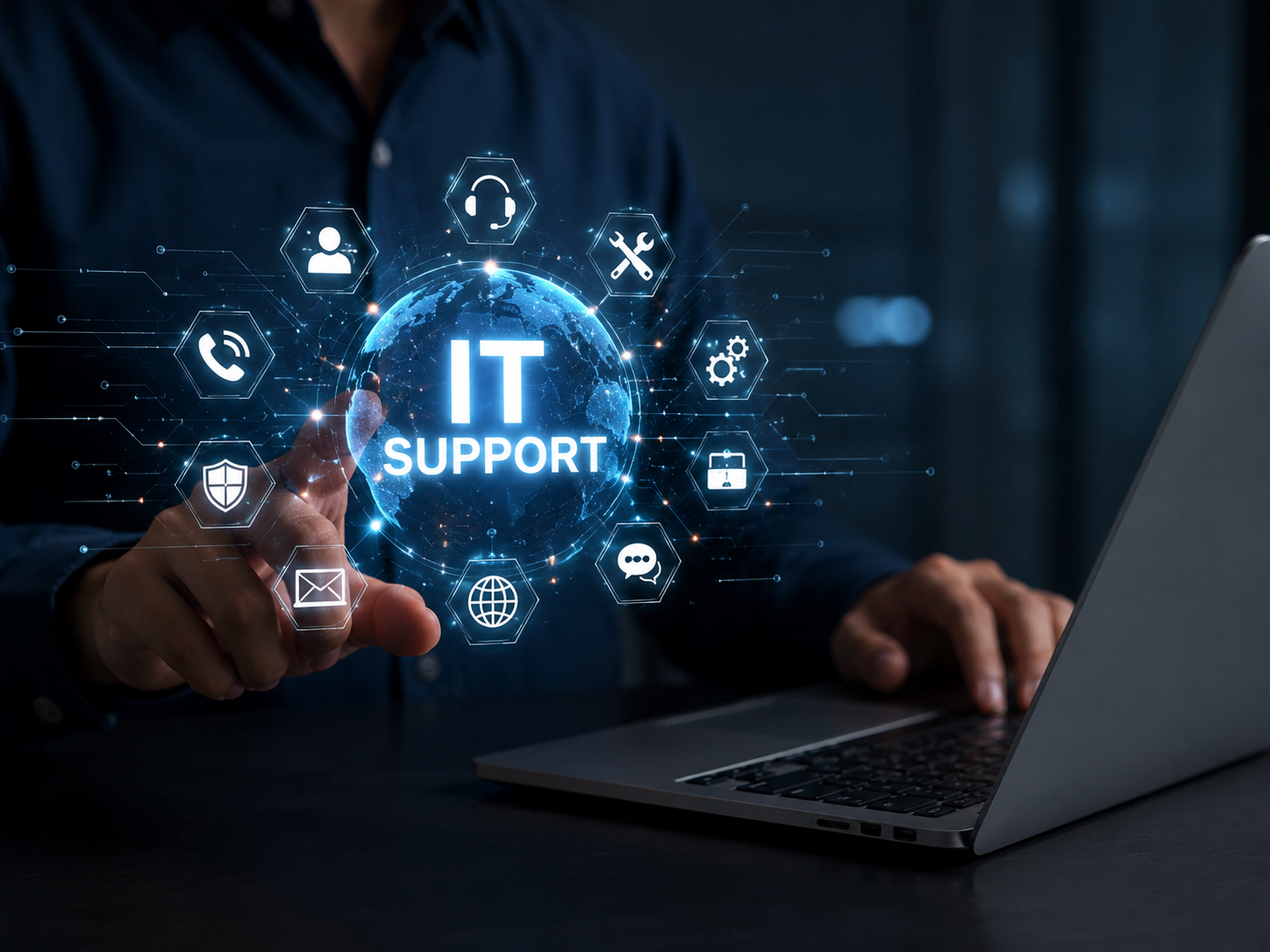
An IT support company can help your business keep its technology running without the cost and responsibility of building a large internal IT team. But outsourcing is not always the right answer. Some businesses work better with an in-house IT department, while others benefit from the flexibility and broader expertise of an outside provider. The right choice depends on your budget, company size, technology needs, security concerns, and plans for growth.
If you are deciding between hiring your own IT staff and working with an outside provider, look beyond the monthly cost. Response time, technical skills, security, maintenance, and scalability all matter when choosing the right IT model. The goal is to choose a solution that provides reliable business IT support while helping your company stay productive and ready for future growth.
Key Takeaways
The right IT setup should support your business today while giving you room to grow tomorrow.
- In-house IT gives you direct control and a team dedicated to your business.
- An IT support company gives you access to a wider range of technical skills.
- Outsourcing can be practical for small and growing businesses.
- In-house teams can be useful when technology needs are highly specialized.
- A hybrid model can combine internal staff with outside IT expertise.
- Cost, security, response time, and scalability should all be considered.
IT Support Company Services
An IT support company provides technology support to businesses on an ongoing basis. Instead of hiring several IT employees, a business can work with an outside team that handles daily technical needs as well as larger IT projects.
The services depend on the provider. Some companies focus mainly on help desk support, while others offer complete managed services that include cybersecurity, cloud solutions, backups, network management, and proactive maintenance.
For example, Axis Computer Networks provides business IT support, network and desktop support, server monitoring, help desk and technical support, cloud services, cybersecurity assessments, and ongoing managed services.
An IT support company may help with:
- Computer and network problems
- Software and hardware issues
- User and account support
- Network and server monitoring
- Security updates
- Data backups
- Cloud services
- Remote and onsite support
The main benefit is simple. You can access different areas of technical expertise without having to build a large IT department yourself.
Understanding In-House IT Teams
An in-house IT team consists of employees who work directly for your company. They know your business, systems, and employees because they are part of the organization.
A small business may have one IT employee who handles most technology problems. A larger company may have a complete IT department with network administrators, system engineers, cybersecurity specialists, and an IT manager.
IT Support Company vs. In-House IT
The biggest difference is how your IT resources are managed. With an in-house team, you hire, train, manage, and pay IT employees directly. With an IT support company, you work with an outside team under a service agreement. Neither option is automatically better. The right choice depends on your business.
For a small company with 20 employees, hiring several IT specialists may not make financial sense. A larger organization with complex internal systems, however, may need dedicated employees who work closely with its teams every day. That is why it is important to look at the full picture instead of simply asking which option costs less.
IT Support Costs
Cost is often the first concern for business owners, but it is easy to compare the wrong numbers. When you hire an in-house employee, the cost is more than their salary. You may also pay for benefits, payroll expenses, training, equipment, software, certifications, recruiting, and time off.
There is also the question of coverage. If your only IT employee is sick or away from the office, who handles an urgent problem? With an IT support company, you typically pay for an agreed set of services. This can make IT spending easier to plan. You may also get access to several technicians instead of relying on one employee.
Your total IT spending may include:
- Employee salaries and benefits
- Recruiting and training
- IT software and tools
- Hardware and equipment
- Security solutions
- Backup systems
- Outside IT services
For many small and mid-sized businesses, outsourcing can provide access to more expertise without the cost of building a full IT department.
Managed Help Desk Support
A managed help desk gives employees a clear way to get technical assistance. Instead of asking the same IT employee for help every time a printer stops working or an application fails, employees can submit a support request. The provider can track the issue, assign it to the right technician, and follow it through to resolution.
This can make a big difference as a company grows. Common help desk requests include password problems, software issues, email problems, device setup, network access, and employee onboarding. A managed help desk can also help identify recurring problems. If the same issue keeps appearing, the IT team can look for the root cause instead of fixing it over and over.
Remote and Onsite IT Support
Not every IT problem requires someone to visit your office. Many everyday problems can be handled through remote IT support. A technician can securely access a system, review settings, install updates, troubleshoot software, or help an employee without being physically present.
Other issues still require onsite IT support. Hardware failures, cabling problems, new equipment installations, and physical network issues are good examples. Businesses do not always have to choose between the two. A strong IT support model can combine remote assistance for everyday problems with onsite service when physical help is needed. This gives employees faster access to support while still providing hands-on help when necessary.
The Importance of IT Maintenance
Good IT support is not just about fixing problems after something breaks. Regular IT maintenance can help prevent problems from becoming larger and more expensive. Updates, backups, monitoring, and security checks can catch issues before they affect your employees.
This type of proactive support can help businesses reduce avoidable downtime and keep technology working properly. Instead of waiting for an employee to report that something is wrong, the IT team can look for warning signs and address them early.
Cybersecurity and IT Support
Cybersecurity should be part of the decision from the beginning. Businesses of all sizes face risks from phishing, stolen passwords, malware, ransomware, and other threats. Protecting company data requires more than installing antivirus software and hoping for the best. An in-house IT team can manage cybersecurity, but the level of protection depends on the team’s experience, tools, and available time. An IT support company may provide access to security specialists, monitoring tools, backup systems, patch management, cloud network services, security audit services, and other solutions designed to protect business systems and data. Cloud network services can help secure and manage cloud-based environments, while security audit services can identify vulnerabilities, gaps in security controls, and areas that need improvement. However, you should always ask an outside provider how it protects your systems and data.
Before choosing a provider, ask about:
- Security monitoring
- Backup protection
- Multi-factor authentication
- Software patching
- Access controls
- Incident response
- Employee security training
When an IT Support Company Makes Sense
Outsourcing IT can be a good fit when you need reliable technical support but do not want to build a large internal department. The right managed IT partner can give your business access to a wider range of technical skills while helping you manage everyday IT needs.
For example, an IT support company may be worth considering if your current employee spends most of the day fixing small problems instead of working on important projects. It can also make sense if your business needs cybersecurity, cloud support, network monitoring, or other skills that your current team does not have. Outsourcing may make sense when you want more IT expertise without taking on the cost and management involved in hiring several specialists. Choosing the right managed IT partner can help you build a reliable IT environment that supports your business as it grows.
When In-House IT Makes Sense
An internal IT team can be a strong choice for larger businesses or companies with highly specialized technology needs.
If technology is at the heart of your business, having dedicated employees may give you the level of control and attention you need. An internal team can also build deep knowledge of your systems and work closely with other departments.
In-house IT may make more sense when you have:
- A large and complex technology environment
- Specialized internal systems
- A strong IT budget
- A need for constant internal IT management
- A large enough team to provide coverage
Even then, an internal team does not have to work alone. Outside support can provide extra expertise when needed.
Choosing the Right IT Support Model
Before making a decision, take a close look at your current IT situation. Think about what happens when a major system goes down, how quickly your team can respond, and who handles cybersecurity. You should also consider whether your IT staff has the skills needed for areas such as cloud computing services, network management, and data security as your business grows.
It also helps to consider how much time your employees lose because of technology problems. If your team is spending too much time dealing with IT issues instead of focusing on their work, the right IT support model can make a big difference.When comparing your options, look at:
- Your number of employees and devices
- Your current IT spending
- Your security needs
- Your existing IT skills
- Your need for remote or onsite support
- Your plans for growth
- Your tolerance for downtime
Once you understand these needs, comparing an IT support company with an in-house team becomes much easier.
Why Businesses Choose Axis Computer Networks
Axis Computer Networks takes a proactive approach to business IT support. Rather than waiting for problems to interrupt your work, the company focuses on monitoring, maintenance, backups, security assessments, help desk support, and other managed services.
The company also supports businesses with network and desktop support, server monitoring, cloud services, remote work solutions, and technical support. This type of approach can be useful for businesses that want reliable IT support without having to manage every part of their technology internally.
Conclusion
Choosing between an IT support company and an in-house IT team is not simply a question of which one costs less. You need to think about the support your employees need today and the technology your business will need tomorrow.
An in-house team can give you direct control and dedicated support. An IT support company can give you access to a wider range of skills, proactive maintenance, flexible services, and ongoing technical support. For some businesses, the best answer may even be a combination of both. Need dependable IT support for your business? Contact Axis Computer Networks today to discuss your business IT support, cybersecurity, IT maintenance, and managed services needs.
Frequently Asked Questions